
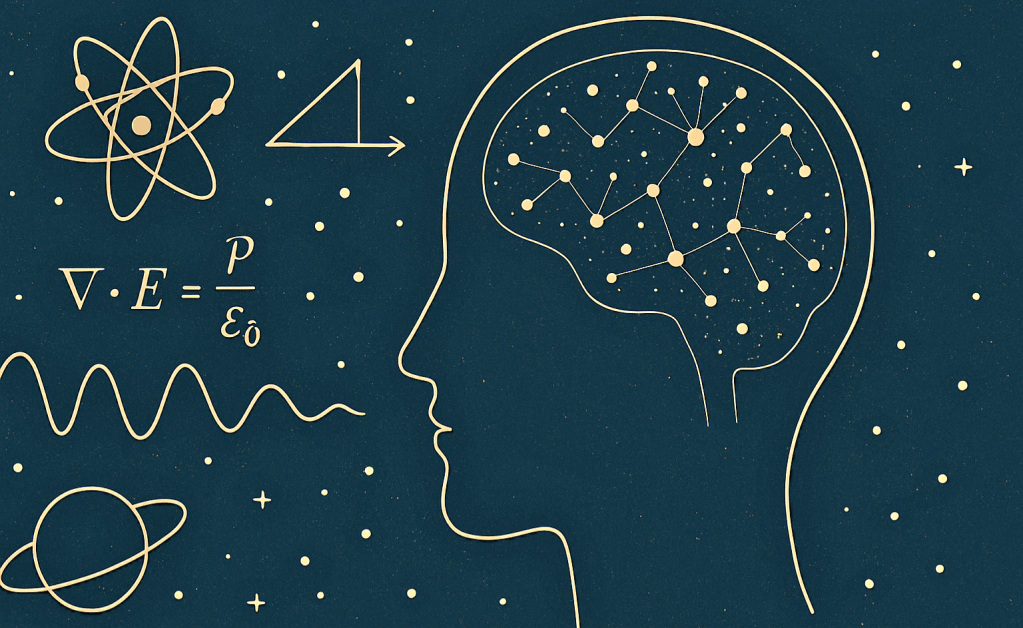
Let’s talk about something you use every single day: your perception.
It’s how you take in the world—what you see, what you feel, what you believe is happening around you.
But have you ever stopped to ask: What actually shapes my perception? Is it just my mind, or could there be more to the story? Believe it or not, the answer might be hidden not just in your thoughts—but in physics.
Yes, the same science that explains how planets move and how light travels… can also help explain how and why we see the world the way we do.
Let’s unpack that.
Your Senses Are Physics in Action
First, a basic truth: everything you experience comes through your senses—sight, hearing, touch, taste, and smell.
But here’s what’s fascinating: those senses are really just tools for detecting energy.
• You don’t see a tree—you see light waves bouncing off it.
• You don’t hear someone’s voice—you pick up vibrations in the air.
• You don’t feel warmth—you sense infrared energy (heat).
In other words, your senses are always responding to physical signals. And perception? That’s the process of interpreting those signals.
So perception isn’t just in your “head.”
It begins in the laws of physics.
The Brain Doesn’t See—It Predicts
Your brain receives constant input—light, sound, movement. But here’s the catch: it doesn’t just take that information in and display it like a movie screen.
Instead, your brain acts more like a predictive engine.
It guesses. It fills in gaps. It matches new input with old memories. It creates meaning based on what it thinks is happening, not always what is happening.
This means your perception is a blend of:
• Physics (real energy data from your environment)
• Past experience (how your brain learned to interpret those signals)
• Current state (your mood, your stress level, your focus)
So when you say “I feel like the world is against me,” what’s actually happening is that your internal filter is shaping what you’re seeing.
The energy hasn’t changed.
But your perception of it has.
Why Two People Can See the Same Thing Differently
This is why two people can walk into the same situation and have completely different reactions.
One might see a room full of strangers as exciting.
Another sees it as terrifying.
One sees rain as refreshing.
Another sees it as depressing.
The physics—the rain, the sound, the environment—is the same.
But the perception is different.
Because we don’t see the world as it is. We see it as we are.
How to Shift Your Perception Using Physics
Here’s the hopeful part:
If perception is influenced by physical signals and internal states, then we actually have more control than we think.
You can shift your perception by shifting:
• Your focus (what you pay attention to)
• Your energy (through movement, breath, rest, light)
• Your environment (sound, color, temperature, space)
Even something as small as opening a window to let in natural light is a physics-based action that can change your sensory input—and with it, your perception.
Your body is tuned like a radio. When you change the frequency, you get a different experience.
It’s Not Woo. It’s Physics.
This may sound spiritual or poetic, but it’s backed by science.
• Light = photons (energy particles)
• Sound = vibrations (mechanical waves)
• Emotions = energetic patterns influencing your nervous system
• Perception = the process of decoding it all
You’re constantly interacting with the world through the laws of energy and motion.
You’re not separate from the universe—you’re wired into it.
Conclusion
Next time you feel stuck in your thinking or weighed down by what you “see,” remember this:
Perception isn’t just mental. It’s physical.
You can shift your reality by shifting your energy, your environment, or even just your attention.
Because sometimes, the change you need is not outside—it’s just a different way of tuning into the same world.
And that’s not magic.
That’s physics doing its quiet, beautiful work—through you.
 Namrata's Diary
Leave a comment